
Two euros may sound like a modest addition to an international order. For businesses selling lower-value products into the EU, however, the proposed handling fee raises a bigger question: how much will each basket cost to deliver once all the charges are accounted for?
The latest announcement brings more clarity to the EU’s customs changes. It also highlights why retailers should look beyond headline amounts when planning pricing, fulfilment and the customer experience.
What has been announced?
The European Commission has adopted a delegated regulation setting the Union handling fee at €2 per item for goods sold through distance sales to customers in the EU. The fee is intended to cover customs processing costs, including data checks, risk assessment, controls and supporting infrastructure. The entity responsible for the item’s other customs charges would also be responsible for the handling fee.
The measure remains subject to scrutiny by the European Parliament and Council. If neither objects, the regulation will enter into force on publication in the Official Journal and apply ten days later. Businesses should therefore avoid presenting 1 November as an unconditional, confirmed start date.
Why €2 and €3 are different charges
The handling fee is separate from the temporary €3 customs duty introduced on 1 July 2026 for qualifying low-value imports. Although the amounts are similar, their purposes differ. The €3 charge is a customs duty; the €2 fee is intended to recover the costs of customs supervision. The handling fee does not replace the duty.
For retailers, the commercial question is how these charges combine with import VAT and any applicable clearance or carrier charges—and who accounts for each amount. That makes it important to assess the complete cost of an order before making pricing decisions.
One parcel does not necessarily mean one fee
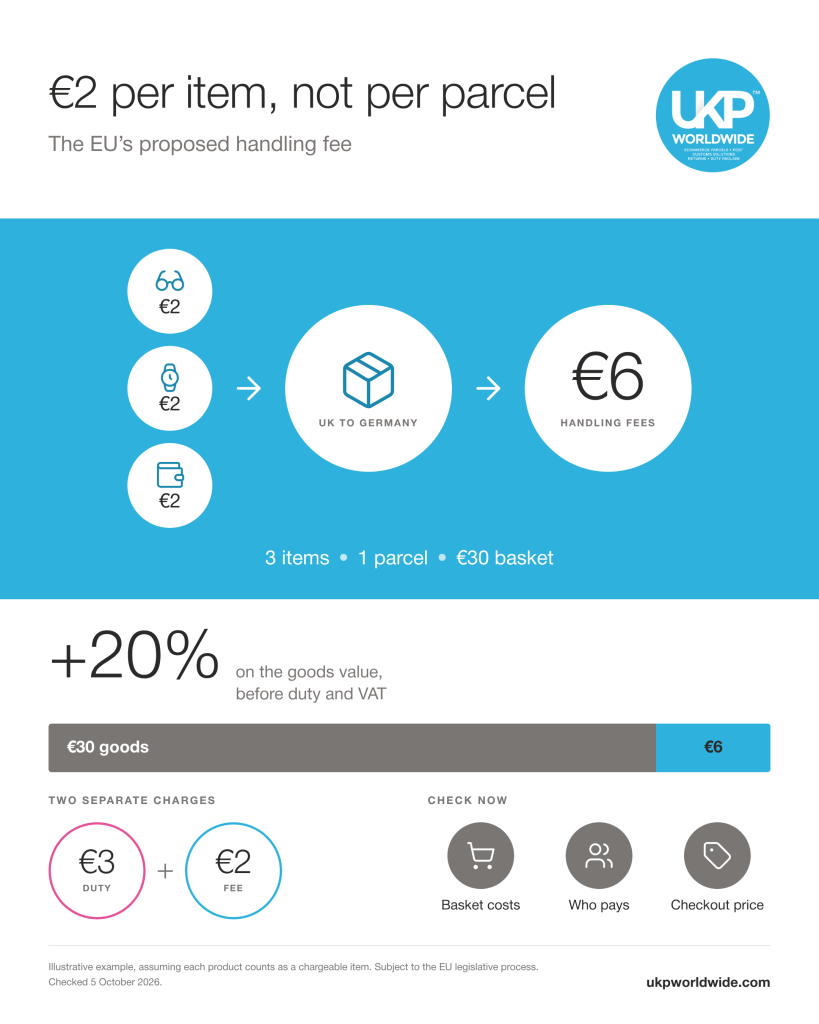
Imagine a UK accessories retailer sending an order to a customer in Germany. The customer buys three products worth €30 in total, all packed in one parcel.
For planning purposes, if each product counts as a separate chargeable item, the handling fee would add €6 to the order. That is equivalent to 20% of the goods’ value, before considering customs duty, VAT or other applicable charges.
This is an illustrative scenario, rather than a confirmed calculation for every three-product basket. Businesses will need to check the applicable definition of “item” and operational guidance before using it in live pricing. The €3 duty must also be calculated under its own rules; retailers should not assume both charges count items in the same way.
The example nevertheless demonstrates the commercial significance of those two words: “per item”. Combining products in one package may reduce transport costs, but it does not automatically reduce an item-based customs charge.
What should businesses do now?
While the legislative process continues, retailers can prepare by reviewing three practical areas:
- Basket economics. Test the potential impact on typical EU orders, particularly baskets containing several lower-priced products. A fixed charge can take a larger share of the margin on a small purchase.
- Responsibility for charges. Establish who will account for each amount across the selling platform, customs arrangements and delivery partners.
- Customer pricing. Consider whether additional costs would be absorbed or reflected in prices, and how customers would see the total at checkout.
These decisions are closely connected. Absorbing a charge may protect conversion but reduce margin. Passing it on may preserve profitability while changing the customer’s perception of value. Understanding that trade-off starts with accurate order-level costs.
The bigger commercial lesson
The €2 announcement is a reminder that cross-border delivery costs are shaped by more than parcel weight and destination. The products inside the parcel, their customs treatment and the responsibilities of each party all matter.
For UK retailers, preparation means connecting customs requirements with pricing, basket composition and delivery promises.
At UKP Worldwide, we see that joined-up approach as essential to keeping EU trade commercially viable and giving customers a clear, predictable delivery experience.
Information checked on 5 October 2026. The handling fee’s application remains subject to the legislative process outlined above.
Sources
- CLECAT: Commission sets Union handling fee at €2 per item, 2 October 2026
- European Commission: EU Customs Reform