Who really owns customs compliance?
This article is for retailers, online marketplaces, fulfilment providers, carriers and logistics partners involved in moving eCommerce goods across international borders. It explains why customs compliance cannot be treated as the responsibility of one supplier alone, where accountability can become unclear and what businesses should establish before goods begin moving.
With UK and EU reforms placing greater responsibilities on sellers and online platforms, understanding who creates, checks and submits customs information is becoming increasingly important.
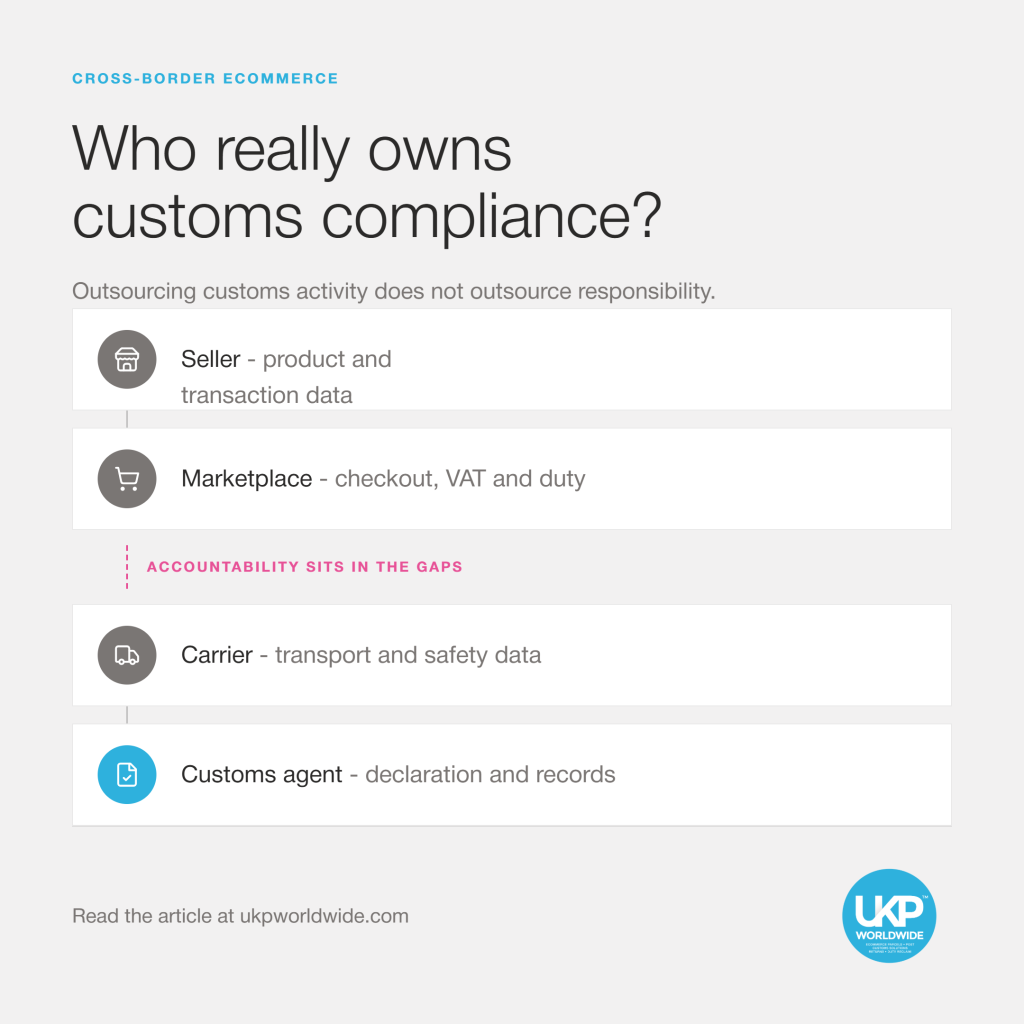
Outsourcing customs activity does not outsource responsibility.
An international eCommerce order may pass through a retailer, marketplace, fulfilment provider, carrier, customs agent and final-mile delivery partner before it reaches the customer.
Each business performs a different part of the process. But when the product description is unclear, the commodity code is incorrect, or the customs value does not match the transaction, who is responsible? The answer is not simply the business that submitted the customs declaration.
Customs compliance is a shared process, but responsibility for the underlying information must still be clearly assigned. A customs agent can prepare and submit a declaration, identify inconsistencies and advise on customs requirements. It cannot, however, manufacture accurate product information that does not exist or correct commercial data that was wrong at source.
This distinction is becoming increasingly important as customs authorities expect more detailed information earlier in the transaction and governments move responsibilities closer to overseas sellers and online marketplaces.
Customs compliance begins with the data owner.
The information needed for customs clearance is created long before a parcel reaches the border. The seller is usually best placed to know what the product is, what it is made from, where it was manufactured and how much it was sold for. A marketplace may control the product listing, customer payment and collection of taxes or duties. The fulfilment provider knows what was packed, while the carrier holds the transport information.
The customs agent brings these different pieces of information together to complete the customs process. The quality of the declaration therefore depends on the quality of the data received from across the supply chain.
If a seller provides a vague description such as “clothing”, “accessory” or “gift”, other parties may not have enough information to determine the correct classification. If the declared value does not reflect the transaction, a carrier or agent may have no independent way to identify the correct amount. If the country of origin has been assumed rather than properly established, the wrong duty may be applied. This is why customs compliance cannot begin at the point of declaration. It must begin with the creation and management of product data.
Online marketplaces are becoming increasingly important within this process. Under the EU Import One Stop Shop, or IOSS, suppliers and qualifying electronic interfaces can collect VAT at the point of sale for imported consignments not exceeding €150. In certain circumstances, a marketplace can be treated as the deemed supplier for VAT purposes.
However, IOSS is a VAT simplification. It does not remove the need for a valid customs declaration or accurate customs data. The party collecting VAT, the importer, the customs declarant, and the business supplying the product information may still be different organisations. European Commission guidance on low-value consignments.
The direction of travel is towards greater marketplace involvement. The European Commission’s proposed customs reforms would make online platforms key participants in ensuring that duties and VAT are paid at purchase. European Commission overview of EU customs reform.
The UK is moving in a similar direction. Under proposed reforms to the customs treatment of low-value imports, overseas sellers and online marketplaces would be responsible for collecting customs duty and accounting for it through a new system. The arrangements are expected to take effect by October 2028 at the latest. UK Government response on low-value import reform.
These developments reinforce a wider point: customs responsibilities are moving closer to the product listing, checkout and point of sale. Retailers and marketplaces will need to treat customs data as a core part of the eCommerce transaction, rather than information assembled only when the parcel is ready to leave.
Outsourcing the declaration is not the same as transferring responsibility
Appointing a customs agent is an important way for businesses to access specialist knowledge and manage complex customs processes. It does not mean the trader can step away from the accuracy of the information being declared.
In the UK, an agent can act as either a direct or indirect representative:
Under direct representation, the agent submits the declaration in the trader’s name and on its behalf. The trader remains responsible for the customs debt and the accuracy of the underlying information.
Under indirect representation, the agent acts in its own name but on behalf of the trader. The agent and the principal may then be jointly and severally liable for the customs debt. HMRC can seek payment from either party. HMRC guidance on customs debt liability.
The type of representation therefore matters, but neither arrangement removes the need for accurate information from the business that understands the products and transactions.
Customs agents have responsibilities of their own. They must understand the authority under which they are acting, maintain appropriate records, conduct reasonable due diligence and question information that appears inconsistent or implausible.
A strong customs relationship is therefore a partnership. The retailer or marketplace provides accurate, complete and properly governed data. The customs agent applies specialist knowledge, challenges potential errors and ensures the information is used within the correct customs process.
Carriers and logistics providers also have defined responsibilities. For example, the carrier moving goods into Great Britain is responsible for ensuring that an Entry Summary Declaration is submitted. A third party may lodge it on the carrier’s behalf, but the carrier remains responsible for making sure the submission takes place. HMRC guidance on Entry Summary Declarations.
This demonstrates the difference between performing an activity and owning responsibility for it. A task may be delegated to another business, but the legal or operational obligation may remain with the original party.
Responsibility must be agreed before the parcel moves
The greatest compliance risks often appear in the gaps between businesses. A marketplace may assume the seller has validated the commodity code. The seller may expect the carrier to classify the goods. The carrier may assume it will receive declaration-ready information from the fulfilment provider. The customs agent may receive only the limited data transmitted through the shipping label.
Everyone has performed their part, but no one has taken ownership of the whole data journey. By the time the problem is identified, the parcel may already be moving. The result can be an incorrect duty calculation, delayed clearance, unexpected customer charges, a rejected declaration or a retrospective customs debt. When the same weakness is repeated across thousands of consignments, a small data problem can become a significant commercial and compliance risk.
For every international sales route, businesses should be able to answer:
- Who determines and approves the commodity code?
- Who confirms the customs value?
- Who establishes and evidences the country of origin?
- Who will act as importer?
- Who calculates and collects duties and taxes?
- Who supplies the customs and safety and security data?
- Is the customs agent acting directly or indirectly?
- Who investigates and corrects inaccurate information?
- Who retains the supporting evidence and audit trail?
If these questions cannot be answered clearly, the compliance model is not clear enough.
Contracts can help define the responsibilities of each party, but contractual wording alone will not make customs data accurate. Responsibilities must also be reflected in operational processes, system integrations, data checks and exception management.
The question businesses should ask is not simply, “Who submitted the declaration?” It is, “Who created the information, who checked it and who was expected to act if something did not look right?”
Customs compliance can be shared across several businesses. It cannot be left to assumption.
As responsibility moves closer to the point of sale, the businesses best prepared for future reforms will be those that define ownership early, maintain reliable product data and involve their customs partners before goods begin moving.
Outsourcing customs activity can provide valuable expertise and operational support. What it cannot do is outsource responsibility for getting the underlying information right.