Peak season doesn’t end at delivery: why retailers need to plan for the January returns wave now

For many retailers, peak season planning focuses on getting orders out of the warehouse and delivered before Christmas. Yet delivery is not the end of the journey.

The purchases made during Black Friday and the weeks leading up to Christmas will create a second operational peak in January. Products will move back through customer service teams, carrier networks, customs, warehouses and finance systems before they can be refunded, restocked or resold.

This is not a minor part of the peak trading cycle. Research from Retail Economics and ZigZag forecast that UK non-food returns would reach £25.1 billion in 2025, equivalent to 19.5% of online orders. Clothing recorded an even higher average return rate of 23.6%.

The lesson for Peak 2026 is clear: a successful festive season cannot be measured by outbound sales and delivery performance alone. Retailers also need a plan for what comes back.

January exposes weaknesses that peak sales can hide

Returns can increase quickly once Christmas is over. In January 2026, more than £1.5 billion of unwanted Christmas purchases were expected to make their way back to UK retailers, with volumes forecast to rise by around 25% during the first full working week of the year. At quieter times, a fragmented returns process may appear manageable. During January, however, every gap becomes more visible.

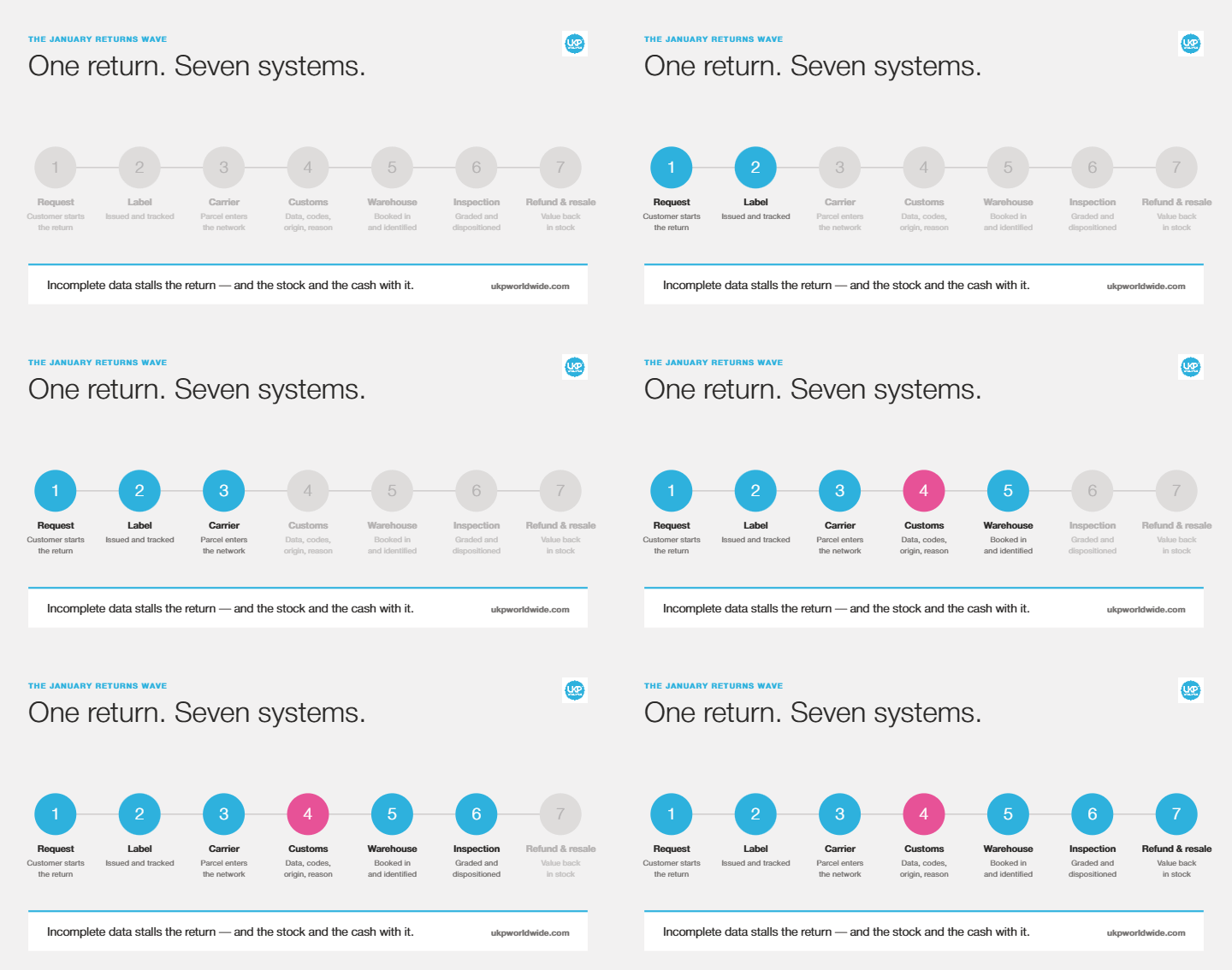
A returned item may need to pass through several separate systems before its journey is complete. The customer requests a return, a label is issued, the parcel enters the carrier network, customs information is submitted, the product arrives at a warehouse, its condition is assessed and the refund is approved.

If the information connecting these stages is incomplete, the return can stall. The warehouse may receive an item it cannot immediately identify. Customer service may not know whether the parcel has crossed the border. Finance teams may issue refunds without knowing what has happened to the stock. Customs evidence may be held separately from the original transaction. The individual delay may seem small, but multiplied across peak-season volumes, it can tie up significant amounts of stock and working capital.

Cross-border returns need more than a label

Domestic returns are largely a logistics exercise. International returns are also a customs exercise. The movement must be supported by accurate information, including the product description, value, commodity code, country of origin and the reason for return. It must also be possible to connect the returned item with the original order and the relevant customs records.

Poor data can result in parcels being delayed, incorrectly treated as new imports or charged duty and tax again. It can also make it more difficult to establish whether a business is entitled to customs relief or a repayment.

Depending on how goods originally moved and where they are being returned, different customs arrangements may apply. For example, Returned Goods Relief can allow eligible goods that were previously exported from the UK to be re-imported with relief from Customs Duty and import VAT. HMRC applies specific conditions, including requirements concerning the identity, condition and timing of the goods.

There may also be opportunities to reclaim import duty previously paid when imported products are subsequently returned and re-exported. Eligibility is not automatic. Businesses need the correct customs procedure and a reliable audit trail linking the import, customer return and subsequent export. If that evidence is not captured as part of the returns process, it can be difficult to rebuild several months later.

The real objective is to recover value quickly

Getting a returned parcel back into a warehouse is only one measure of success. The more important question is how quickly the business can recover value from it.

Seasonal products have a particularly short resale window. A winter coat received and inspected in early January may still be returned to stock and sold at a reasonable margin. The same coat sitting unidentified in a returns queue for several weeks may eventually require a heavier discount, be diverted to an outlet or miss the season completely.

This creates a direct link between returns processing and inventory planning. Retailers need clear rules for inspection, grading and disposition before January volumes arrive. Teams should know whether products can be:

  • returned immediately to available stock
  • cleaned, repaired or repackaged
  • resold through an alternative channel
  • consolidated and returned to their country of origin
  • recycled or responsibly disposed of

Visibility matters throughout this process. Customer service, warehouse, finance and customs teams should not be working from different versions of the same return.

Planning should begin before the first peak order

September may feel early to prepare for January, but the returns process needs to be tested before peak trading begins. Retailers should use the coming weeks to examine whether their returns policy, carriers, customs arrangements, warehouse capacity and internal systems can manage a sudden increase in volume. They should also confirm what data will be captured when a return is initiated and whether it can be matched with the original sale, import declaration and export movement.

Useful questions include:

  • Can every returned item be linked to its original order?
  • Is the product and customs data complete and consistent?
  • Who is responsible for the return declaration?
  • Can the business identify returns that may qualify for duty recovery?
  • How quickly can an inspected item become available for resale?
  • What happens when a parcel arrives without the expected data?
  • Do customer service teams have visibility of the complete return journey?

Peak season does not finish when the final Christmas order reaches the customer. It finishes when returned products have been identified, cleared, refunded and placed back into the most appropriate sales or recovery channel.

Retailers that treat January as part of peak planning will be better placed to protect margin, release working capital and recover more value from the stock that comes back.

Sources


CPTPP is now fully open to the UK. What does it mean for exporters?

The UK has reached an important milestone in its membership of the Comprehensive and Progressive Agreement for Trans-Pacific Partnership (CPTPP). Following Canada’s ratification of the UK’s accession, the agreement now applies between the UK and all 11 other members of the trading bloc.

From 1 September 2026, UK businesses can access CPTPP arrangements with Australia, Brunei, Canada, Chile, Japan, Malaysia, Mexico, New Zealand, Peru, Singapore and Vietnam.

The headline opportunity is significant. The UK Government says that more than 99% of current UK goods exports to CPTPP members will be eligible for zero tariffs over time. The agreement also covers services, investment and government procurement.

For exporters, however, access to a trade agreement and entitlement to its benefits are not the same thing.

Zero tariffs are not automatic

The 99% figure could easily be interpreted as a blanket removal of customs duty. In practice, preferential treatment depends on the product’s commodity code, the destination country’s tariff schedule, any tariff phase-out period and whether the goods meet the relevant rule of origin.

Goods do not acquire UK origin simply because they are sold by a UK business or dispatched from a UK warehouse. A product manufactured in a non-member country and resold from the UK may remain non-originating.

This is particularly relevant to eCommerce retailers sourcing internationally and selling the same goods into several markets. To claim CPTPP preference, a business may need to establish where a product was made, where its materials came from and whether any processing met the product-specific origin rule.

An incorrect preference claim can lead to duty being recovered after import, alongside additional administration and possible compliance concerns.

Cumulation could reshape sourcing decisions

One potentially valuable feature of CPTPP is cumulation. In broad terms, qualifying materials and production from participating CPTPP countries may be counted when determining whether a finished product is originating.

For a UK manufacturer with a supply chain spanning several CPTPP markets, this may make it easier to meet an origin rule. It could also influence future sourcing and production decisions.

Cumulation is not a shortcut, however. Each product must still meet its specific rule, which might require a change in tariff classification, a regional value calculation or a particular manufacturing process. Origin therefore needs to be assessed at product level and supported by reliable supplier and production records.

Canada brings an additional choice

Canada’s ratification is especially interesting because the Canada-UK Trade Continuity Agreement remains in force alongside CPTPP.

Businesses trading between the UK and Canada may therefore have more than one route to preferential treatment. The best option will not necessarily be the same for every product. The two agreements can have different origin rules, tariff treatments and documentary requirements.

Rather than automatically using the newest agreement, exporters should compare the available options. CPTPP may provide the better outcome in some cases, while the existing bilateral agreement may remain more suitable in others.

Tariff optimisation is not simply about finding a zero rate. It means identifying which rate is legally available, confirming that the goods qualify and holding evidence to support the claim.

The customs border remains

CPTPP is a free trade agreement, not a customs union or single market. Export and import formalities still apply when goods move between members.

Businesses must still consider classification, customs value, origin evidence, declarations, local taxes and product-specific controls. Responsibilities between the seller, buyer, carrier and customs representative must also be clear.

A lower tariff may improve the landed cost, but it does not remove the wider operational requirements of entering a new market. Delivery charges, tax arrangements, local regulation, returns and the customer experience remain part of the commercial calculation.

Turning access into an advantage

Businesses considering CPTPP markets should begin with a focused review of their products and supply chains. Key questions include:

  • What is the correct commodity code?
  • What are the standard and preferential tariff rates?
  • Which origin rule applies?
  • Can the business demonstrate how and where the goods were produced?
  • Is CPTPP the most appropriate agreement for the transaction?
  • Can the required evidence be produced if the claim is checked?

Some products may already enter at a zero standard rate, making preference unnecessary. For others, the saving could be meaningful but dependent on stronger supply-chain data.

Full access to CPTPP may support lower tariffs, more flexible sourcing and new export opportunities. But its value will be determined product by product and supply chain by supply chain. The businesses most likely to benefit will combine commercial ambition with accurate classification, a clear understanding of origin and reliable evidence.

The opportunity is real. Turning it into an advantage begins with understanding the detail.

Sources