The Hidden Cost of International Returns That Most Retailers Never Measure

Ask most retailers what international returns cost, and they’ll usually point to reverse logistics, processing, customer service and lost sales. Ask them what those same returns cost in customs duties, delayed inventory and unrecovered cash flow, and many couldn’t give you an answer.

That’s because cross-border returns have traditionally been viewed as a customer service issue rather than a customs issue. Yet as international eCommerce continues to mature and retailers face growing pressure on profitability, that mindset is becoming increasingly outdated.

The reality is that returns are no longer simply the final stage of the customer journey. They have become an integral part of international trade, with customs, compliance and data now playing a far greater role than many businesses appreciate. Retailers that continue to view returns solely as an operational cost may be overlooking opportunities to improve cash flow, recover costs and strengthen the efficiency of their wider supply chain.

Cross-border eCommerce has transformed how retailers reach consumers around the world, but it has also created increasingly complex reverse logistics networks. While significant investment has been made in optimising outbound fulfilment, many returns processes remain fragmented. Customer service teams, warehouse operations, logistics providers, finance departments and customs specialists often work independently, each managing their own part of the process with limited visibility of the complete journey. That separation has consequences.

A product may leave a warehouse with complete customs documentation, be successfully imported into another country, sold to a consumer and then returned weeks later through an entirely different channel. Somewhere along that journey, the connection between the original import, the returned product and the associated customs declarations is frequently lost. When that happens, retailers are not simply dealing with operational inefficiencies; they may also be missing opportunities to recover costs that have already been incurred.

This is becoming increasingly important as businesses place greater emphasis on profitability rather than simply driving sales growth. Rising transport costs, higher labour expenses and continued pressure on margins mean that finance teams are scrutinising every part of the supply chain for opportunities to reduce unnecessary expenditure. Returns, once viewed as an unavoidable cost of doing business, are now attracting much closer attention.

From customer service challenge to customs challenge

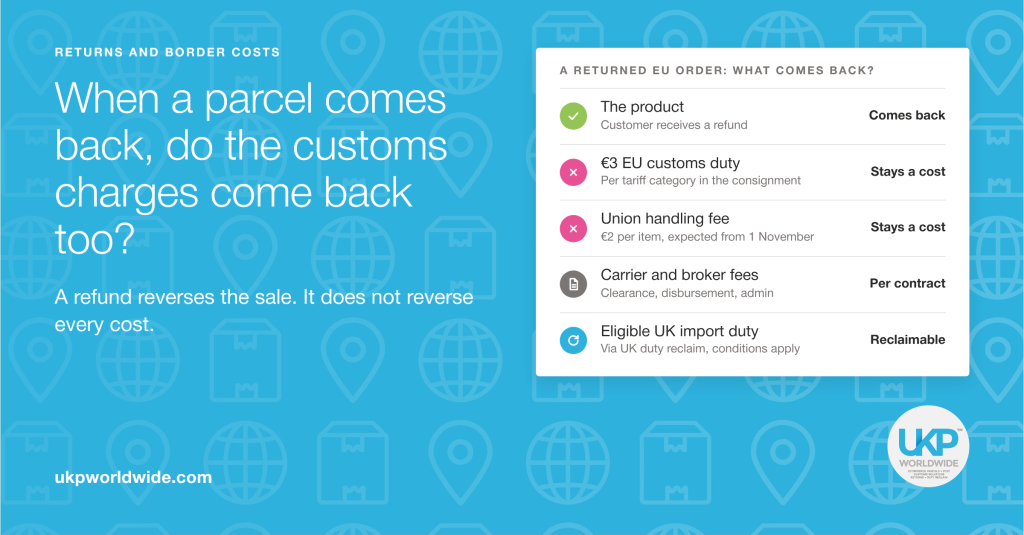
Many retailers remain unaware that, under the right circumstances, import duty paid on goods can be reclaimed when those products are subsequently returned. Returned Goods Relief (RGR) provides an important mechanism for recovering duty on qualifying goods, yet awareness remains surprisingly low outside customs and trade compliance teams. Even where businesses are aware of the relief, many struggle to capture the evidence and data required to support successful claims.

The challenge is rarely the legislation itself. More often, it is the quality and availability of information.

Successful duty recovery depends upon maintaining a clear audit trail between the original import, the exported goods, the returned products and the relevant customs declarations. That sounds straightforward in principle but becomes considerably more difficult when products pass through multiple fulfilment partners, marketplaces, warehouses and returns providers across different countries. Without accurate data, reclaim opportunities can simply disappear.

For retailers handling thousands, or even millions, of cross-border parcels each year, this represents far more than an administrative inconvenience. Small amounts of unrecovered duty on individual consignments can accumulate into substantial sums over time. In an industry where percentage points matter, recovering costs that have already been paid can have a meaningful impact on operating margins. The financial implications extend beyond duty alone.

The next evolution of cross-border returns

Returns that are not efficiently processed through customs can delay products from being returned to available inventory. This creates additional warehousing costs, ties up working capital and reduces the opportunity to resell products while demand remains high. Fashion retailers understand this particularly well, where seasonal inventory rapidly loses value if it cannot be returned to stock quickly enough. The same principle increasingly applies across consumer electronics, sporting goods, homeware and many other retail sectors.

Perhaps more importantly, disconnected returns processes reduce visibility. Businesses often know how many products have been returned, but not necessarily how much those returns are truly costing once customs charges, delayed inventory, administrative handling, transportation and unrecovered duties are considered together. This is where the conversation needs to evolve.

Too often, customs continues to be viewed as an activity that begins when goods cross a border and ends once they have cleared. In reality, customs now forms part of the entire product lifecycle. The original import, onward sale, customer return, potential refurbishment, re-export or resale are all connected events that increasingly depend upon consistent, accurate data. That shift reflects a wider transformation taking place across international trade.

Customs authorities around the world are moving away from document-led border processes towards data-led compliance. Governments are investing heavily in digital customs systems that provide greater visibility throughout global supply chains. Increasingly, it is the quality of the data accompanying a shipment, rather than the paperwork itself, that determines how efficiently goods move across borders. Returns are becoming part of that digital journey.

Retailers that continue to treat returns as a standalone customer service process may find themselves at a disadvantage compared with businesses that integrate customs data, inventory systems and financial reporting into a single end-to-end view. The objective is no longer simply processing a returned parcel; it is understanding the complete commercial lifecycle of that product and ensuring every available financial and customs opportunity is captured along the way. There is also a growing strategic dimension to this discussion.

As environmental considerations continue to influence retail operations, businesses are working to extend product lifecycles through refurbishment, resale, repair and recommerce models. These circular economy initiatives depend upon goods moving efficiently across international borders, often multiple times during their lifespan. Customs processes that were originally designed around linear supply chains are therefore becoming increasingly central to enabling more sustainable business models.

In this context, returns are no longer the end of a transaction. They represent the beginning of another commercial opportunity.

The retailers that are adapting most successfully are those looking beyond individual departments and examining the complete flow of products, information and money throughout their supply chains. They recognise that improving returns is not solely about reducing customer effort. It is about strengthening financial performance, improving inventory utilisation, protecting compliance and unlocking value that has often remained hidden for years.

International returns have always been part of cross-border eCommerce. What has changed is their significance.

As customs requirements become more data-driven, margins remain under pressure and global supply chains continue to evolve; returns deserve to be viewed not as an operational afterthought but as a strategic business function. The organisations that recognise this earliest are unlikely to be the ones with the lowest return rates. They will be the ones that understand the true cost of every return and have built the systems, processes and visibility needed to recover as much value as possible.

The hidden cost of international returns is not simply the parcel coming back. It is everything that happens afterwards.


A Few Days On: What Has the First Week of the EU’s New Customs Rules Taught Us?

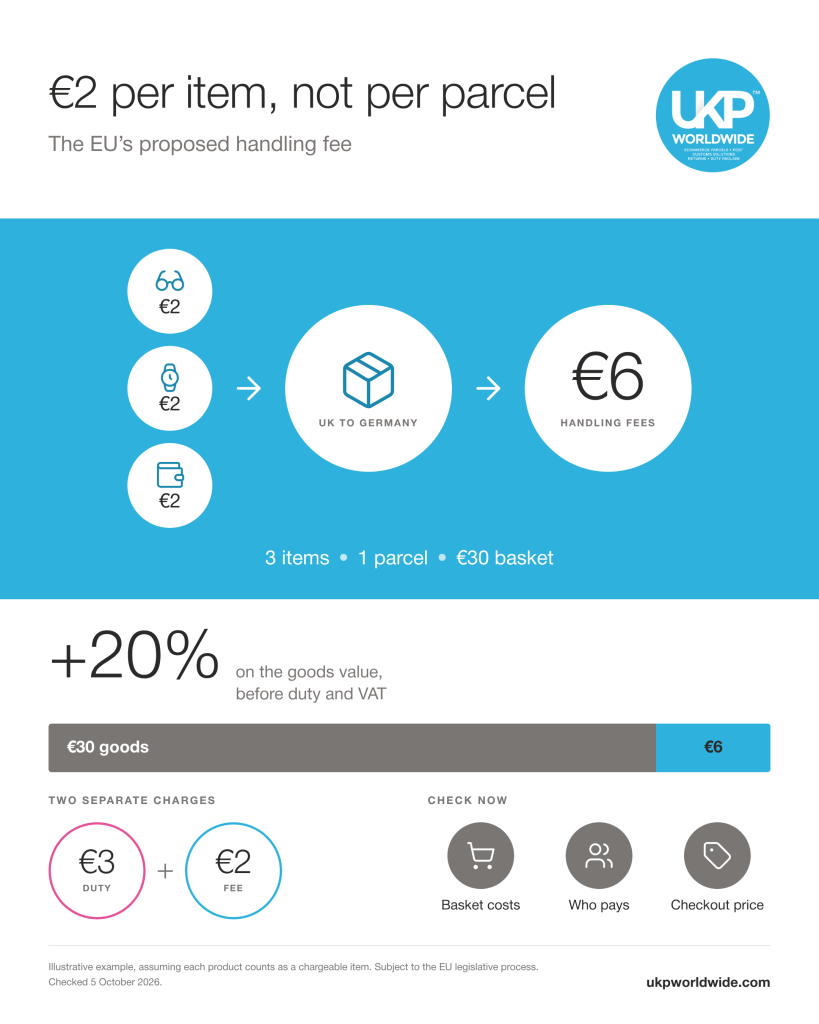
The introduction of the EU’s new customs charging model on 1 July marked one of the biggest changes to low-value cross-border eCommerce in recent years. While many retailers spent months preparing for the new rules, the first few days since implementation have provided a clearer picture of how the industry is responding—and perhaps more importantly, where uncertainty still remains.

As with any significant customs reform, the regulations themselves were only part of the story. The real challenge has always been how businesses choose to implement them.

Different retailers, different strategies

Across the market, there doesn’t appear to be a single approach. Some retailers have chosen to absorb the additional customs costs, protecting the customer experience but accepting reduced margins. Others have opted for greater pricing transparency, incorporating the new charges into checkout so customers know exactly what they are paying before they complete their purchase. Some businesses continue to review their pricing strategies altogether as they assess the longer-term impact on profitability and consumer behaviour.

For customers, transparency is likely to become one of the biggest differentiators. Unexpected charges at the point of delivery have never been popular, and as cross-border shopping becomes more regulated, consumers increasingly expect to see the full landed cost before they click “Buy Now”. Larger marketplaces were widely expected to have these changes ready ahead of launch, while many independent retailers have spent the first week refining their checkout experience and reviewing how the new costs should be presented.

Customs has become a commercial decision

What has perhaps become even more obvious is that customs is no longer simply a back-office function. Decisions around customs charges now influence pricing strategy, customer experience, conversion rates and even brand perception. A retailer’s customs process has become part of the overall customer journey.

The conversation across the industry has also shifted. Only a few months ago, much of the focus was on understanding the legislation. Today, businesses are asking different questions. How should these additional costs be communicated? How much should be absorbed? What effect will they have on basket values? Will customers continue to purchase if prices increase? These are commercial decisions as much as customs ones, and there is unlikely to be a one-size-fits-all answer.

Why accurate customs data matters more than ever

The first few days have also reinforced another important lesson: high-quality customs data matters more than ever. As customs authorities continue their move towards greater digitalisation and increased data-led compliance, the quality of the information submitted with every shipment is becoming just as important as the parcel itself. Accurate commodity codes, product descriptions, values and origin data all contribute to faster, more predictable customs clearance while helping retailers avoid unnecessary delays or additional queries.

Clearing up confusion

For businesses still feeling uncertain, that’s perfectly understandable. Every major customs change brings a period of adjustment. The good news is that these aren’t challenges retailers have to navigate alone. Experienced customs partners can help businesses understand how the regulations apply to their specific supply chain, review clearance processes, identify potential risks and ensure shipments continue moving smoothly across borders.

At UKP Worldwide, we’ve spent more than 25 years helping retailers navigate changes in international customs requirements. Rather than simply processing declarations, we work alongside businesses to simplify complex regulations, provide practical guidance and ensure customs becomes an enabler of international growth rather than a barrier to it.

Looking ahead

The first week has shown that the new rules are already becoming business as usual. The retailers that adapt most successfully won’t necessarily be those with the lowest costs—they’ll be the ones that combine clear customer communication, accurate customs data and efficient clearance processes to deliver the seamless cross-border experience that consumers increasingly expect.

As the industry gathers more data over the coming weeks and months, we’ll continue sharing practical insights to help retailers understand not just what the rules are, but what they mean in the real world.

The End of “Cheap Cross-Border Shipping” – Is Data Becoming the New Cost?

For years, the conversation around cross-border eCommerce has centred on shipping rates, duties and taxes. Retailers have focused on finding the most cost-effective delivery solutions, reducing transit times and managing the financial impact of international trade.

But a significant shift is taking place beneath the surface.

Around the world, customs authorities are fundamentally changing the way they manage goods crossing borders. The traditional model of document-based compliance is rapidly being replaced by a data-driven approach, where authorities expect more information, earlier in the shipping journey and at a far greater level of detail than ever before.

As a result, the future cost of cross-border trade may not be measured by duties or transportation charges alone. Increasingly, the real cost will be determined by the quality of the data businesses provide.

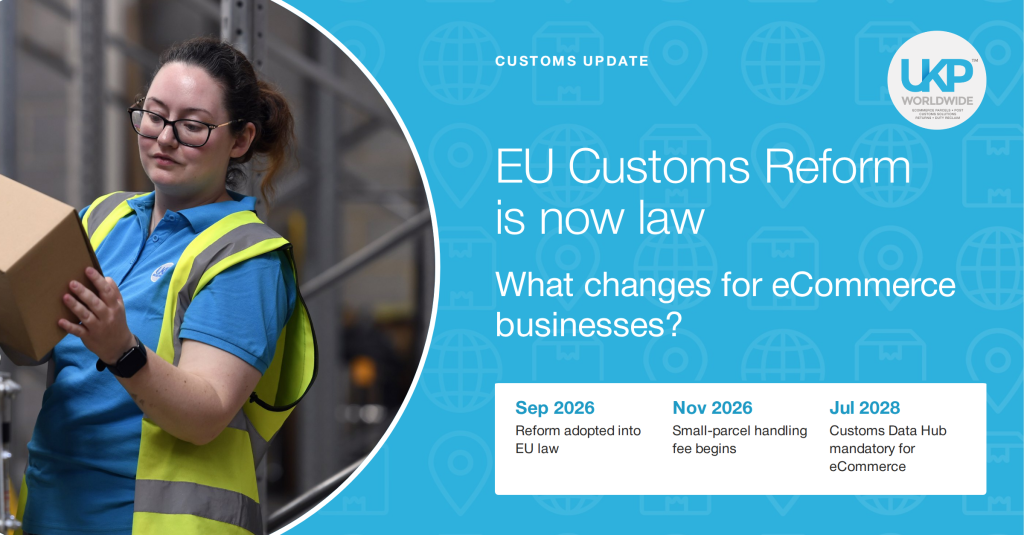
This transition can be seen across multiple customs initiatives currently being implemented. Within the European Union, customs reforms continue to reshape the information requirements placed on businesses selling directly to consumers. The proposed creation of the EU Customs Data Hub, combined with new low-value import procedures, reflects a broader objective: greater visibility of goods before they arrive at the border.

At the same time, the EU’s Import Control System 2 (ICS2) is steadily expanding. While initially focused on safety and security declarations, ICS2 represents a much larger evolution in customs control. Authorities are moving away from relying on physical inspections and paperwork, instead using advanced risk assessment systems that analyse shipment data before goods even leave their country of origin.

The effectiveness of these systems depends entirely on the quality of the information submitted. Inaccurate descriptions, incomplete product information or missing data elements can all trigger delays, additional scrutiny or requests for further information.

Perhaps the clearest example of this trend is the growing emphasis on product-level reporting.

Historically, many customs declarations relied on broad product descriptions and consolidated shipment information. That approach is becoming increasingly difficult to sustain. Authorities now want greater visibility into the specific products being sold, where they originate, how they are classified and, in some cases, detailed product identifiers that allow individual items to be tracked more accurately through the supply chain.

The direction of travel is clear. Customs agencies are seeking richer datasets that provide a more complete picture of what is entering their markets.

This is particularly relevant in the low-value goods sector, which has experienced explosive growth alongside the expansion of global eCommerce. For many years, low-value consignments benefited from simplified processes designed to facilitate trade and minimise administrative burdens. However, the sheer volume of parcels now crossing borders has prompted regulators to reassess the level of oversight required.

As governments seek to tackle issues ranging from product safety and counterfeit goods to revenue protection and fair competition, low-value shipments are attracting increasing scrutiny. The assumption that a low-value parcel automatically represents a low-risk shipment is gradually disappearing.

For retailers, marketplaces and logistics providers, this presents both a challenge and an opportunity.

Businesses that continue to treat customs data as a final administrative task may find themselves facing higher compliance costs, increased intervention rates and operational disruption. The organisations that thrive will be those that view customs data as a strategic asset rather than a regulatory requirement.

Investing in better product information, stronger system integrations and more robust data management processes may not seem as visible as negotiating lower shipping rates. However, as customs authorities become more data-driven, these investments are likely to deliver far greater long-term value.

The reality is that customs authorities are no longer simply moving goods across borders. They are processing information. Every declaration, risk assessment and clearance decision is increasingly driven by data rather than paperwork.

For businesses involved in international eCommerce, this raises an important question. In a world where customs decisions are powered by data, are you investing enough in the quality of your data?

The next decade of cross-border trade may not be defined by who can ship the cheapest. It may be defined by who can provide the best data.

UKP Worldwide Featured by Metro as One of the ’10 Top Brands Making Business Life Easier Right Now’


We’re pleased to share that UKP Worldwide has been featured by Metro in its latest business feature, 10 Top Brands Making Business Life Easier Right Now.

The feature highlights organisations helping businesses overcome today’s operational challenges through specialist expertise, innovation and trusted services. UKP Worldwide was recognised for supporting retailers, marketplaces, carriers and fulfilment providers with customs clearance, compliance and cross-border eCommerce solutions.

As international trade continues to evolve, businesses are navigating changing customs requirements, increasing regulatory complexity and growing expectations around delivery performance. With more than 25 years of experience, our team works with customers to simplify these challenges, helping goods move efficiently across borders while maintaining compliance.

We’re proud to be recognised by one of the UK’s most-read news brands and to stand alongside other organisations helping businesses operate more effectively.

You can read the full Metro feature here: https://metro.co.uk/2026/06/30/10-top-brands-making-business-life-easier-right-now-28874747/

Thank you to our customers, partners and colleagues whose continued support enables us to deliver specialist customs and eCommerce solutions every day.

UKP Worldwide Reflects on Valuable Discussions at WMX Europe 2026

Last week, the UKP Worldwide team travelled to Athens to exhibit at WMX Europe 2026, joining postal operators, carriers, marketplaces, retailers and logistics providers from around the world for several days of discussion around the future of cross-border commerce.

As the international eCommerce landscape continues to evolve, events such as WMX provide an important opportunity for the industry to come together, exchange ideas and explore the challenges that businesses will need to navigate over the coming months and years.

One of the strongest themes throughout the event was the increasing importance of customs and data. As governments introduce new regulatory requirements and digital customs initiatives continue to develop, businesses are recognising that successful cross-border operations are no longer driven solely by transportation networks. The quality, accuracy and availability of customs data is becoming just as critical to ensuring goods move efficiently across borders.

Alongside customs transformation, discussions also centred on the continued growth of cross-border eCommerce, changing consumer expectations, sustainability, delivery performance and the increasing need for collaborative partnerships throughout the supply chain. With retailers expanding into new international markets, having resilient, compliant and scalable logistics solutions is becoming essential.

For UKP Worldwide, the event provided an excellent opportunity to reconnect with existing customers and industry partners while also meeting many new organisations looking to strengthen their international operations. Conversations covered a wide range of topics including customs clearance, returns management, duty reclaim opportunities and how businesses can simplify increasingly complex international supply chains.

Beyond the exhibition floor, WMX Europe once again demonstrated the value of bringing together experts from across the global postal and logistics community. The open sharing of experiences, market developments and emerging challenges provides valuable insight that benefits the wider industry and helps shape future thinking.

We would like to thank everyone who took the time to visit our stand, meet with our team and share their perspectives. The conversations throughout the week reinforced the importance of collaboration as our industry continues to adapt to an increasingly data-driven and compliance-focused environment.

The team has returned from Athens with plenty of new ideas, valuable connections and fresh insights that will continue to support our customers as international trade and cross-border eCommerce continue to evolve.