The EU has adopted its new Union Customs Code, setting in motion a phased overhaul of how goods are declared, assessed and cleared across the bloc. Published on 19 September 2026, the reform establishes an EU Customs Authority and a shared Customs Data Hub. For eCommerce businesses, its most significant change may be who is expected to take responsibility when a sale crosses the border.
Under the new framework, non-EU sellers and online platforms selling to EU consumers will take on greater responsibility for customs formalities, duty payments and product compliance. The European Commission describes this as a shift away from placing those obligations on the individual consumer. In practice, it raises a question for every business involved in a cross-border order: who holds the information needed to show what was sold, what it is worth and whether it meets EU requirements?
What changes, and when?
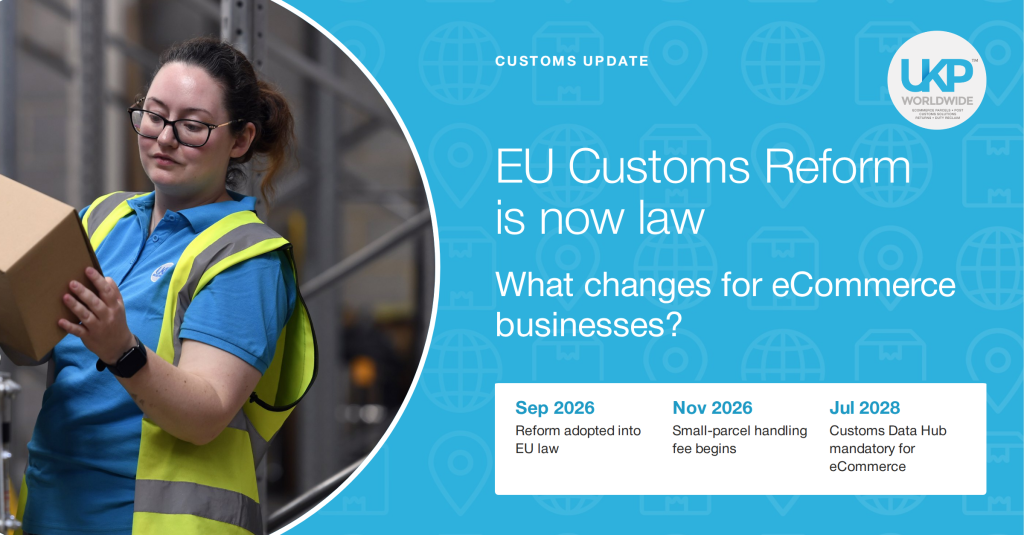
Some elements of the reform are already in place. The new EU Customs Authority, based in Lille, was legally established in September 2026. It will support more consistent risk assessment and coordination between national customs authorities, with operations expected to begin in 2027.
The EU also plans to introduce a handling fee for small parcels from November 2026 to help cover customs supervision costs. Its amount has not yet been set; the Commission will establish it through a separate delegated act. This fee is distinct from the temporary €3 customs duty that has applied to qualifying low-value eCommerce imports since 1 July 2026. Businesses assessing the cost of an EU sale will need to keep those charges separate from import VAT and any commercial clearance or delivery charges.
The larger systems change follows in July 2028, when use of the EU Customs Data Hub becomes mandatory for eCommerce consignments. The Hub is intended to give businesses a single interface for customs information and authorities a shared view of goods moving into and out of the EU. It will be introduced more gradually for other types of trade.
Why responsibility matters more than the new fee
It would be easy to view this reform chiefly as another change to parcel costs. The deeper change is to the relationship between the sale, its data and the business accountable for the import.
Today, information about a shipment can sit across a retailer, marketplace, fulfilment provider, carrier and customs representative. The new framework places greater responsibility on sellers and platforms while giving customs authorities more consistent data for EU-wide risk assessment. Product information therefore needs to travel accurately through that chain, from the point of sale through to customs clearance.
For retailers and logistics partners, preparation starts with a practical review of each sales model. Who will be responsible for the import formalities? Who supplies and checks product descriptions, values and classification data? Who accounts for duty and fees? And who can provide evidence that products meet the relevant EU rules? The answers may differ between a retailer’s own website, a marketplace sale and a shipment handled through a third-party fulfilment network.
The reform is now law, but its measures will arrive in stages. The immediate task is to understand where accountability and information sit today, then identify the gaps before the new eCommerce data requirements take effect. That will matter long after the November handling fee has been set.
Sources
- European Commission: EU Customs Reform announcement
- European Commission: EU Customs Reform overview
- Official Journal: Union Customs Code regulation