
For many years, low-value import thresholds helped cross-border eCommerce grow. Parcels below a set value could enter a market without customs duty, while simplified processes kept millions of relatively inexpensive shipments moving through the border.
These rules were designed for a very different retail environment. Low-value parcels once represented a small part of international trade. Today, they are central to the way consumers shop.
As volumes have grown, governments around the world have begun asking the same question: do rules created to manage occasional low-value imports still work when eCommerce generates millions of individual transactions every day? Increasingly, the answer appears to be no.
A global shift, not an isolated policy change
The approaches being taken are not identical, but the direction is increasingly consistent. In the UK, the Government has confirmed that the customs duty relief currently available on goods valued at £135 or less will be removed. A new customs arrangement is expected to take effect by October 2028, with further work required to determine how duty should be calculated, collected and reported.
The EU has moved more quickly. From 1 July 2026, it removed the customs duty exemption for goods valued at €150 or less and introduced a temporary €3 customs duty on low-value items. This is intended as an interim measure ahead of wider EU Customs Union reforms.
The United States has taken a different route, suspending duty-free de minimis treatment for commercial goods valued at $800 or less from all countries. The change followed an earlier suspension covering goods from China and Hong Kong.
Elsewhere, countries including Australia and New Zealand have already introduced models that require overseas sellers or marketplaces to collect tax on low-value goods at the point of sale. These are separate policy decisions, shaped by different domestic priorities. Taken together, however, they point to a wider reassessment of how low-value eCommerce should be managed.
Why are governments reaching similar conclusions?
The clearest pressure is volume. The European Commission reported that approximately 4.6 billion low-value consignments entered the EU in 2024, equivalent to around 12 million parcels every day. This was twice the volume recorded in 2023 and three times the level seen in 2022.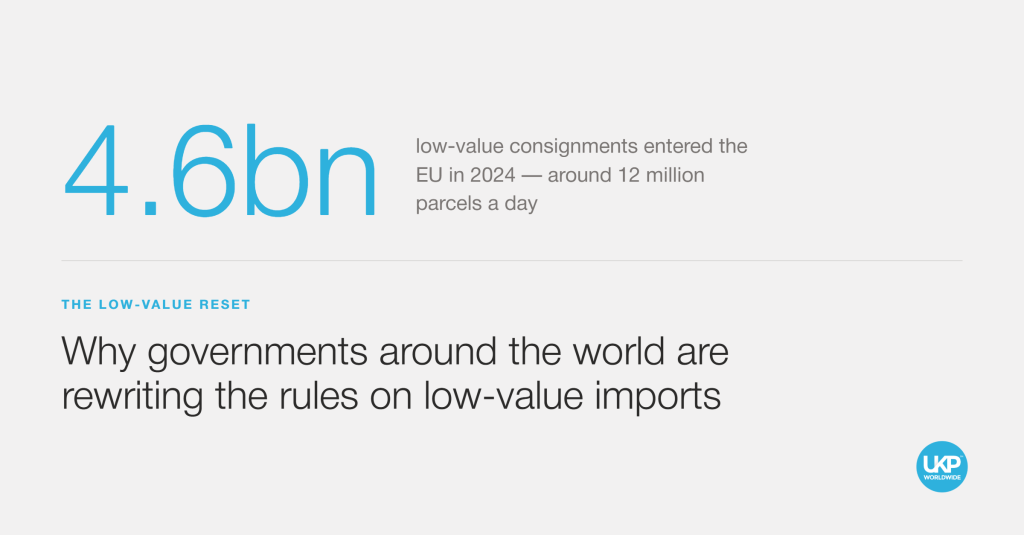
At this scale, a customs exemption is no longer dealing with a marginal category of trade. It covers a significant and fast-growing share of consumer imports.
Revenue is part of the discussion, but it is not the only concern. Governments and domestic retailers have questioned whether exempting imported goods from duty creates an imbalance when businesses operating within the destination market must meet local tax, employment, product and environmental requirements.
Product safety has also become a prominent issue. High parcel volumes make it difficult for authorities to identify goods that are unsafe, counterfeit, incorrectly described or non-compliant with local standards. The European Commission has linked its eCommerce reforms directly to consumer protection and more effective enforcement.
There is also the question of customs capacity. Inspecting every parcel manually would be neither realistic nor proportionate. Simplified processes were created partly because the cost of assessing individual low-value transactions could outweigh the revenue collected.
What has changed is the technology. Advance electronic data, automated risk analysis and direct links between marketplaces, carriers and customs authorities are making it more practical to assess transactions before goods reach the border. Governments can increasingly identify higher-risk shipments without treating every low-value parcel in the same way.
The debate is therefore moving beyond whether low-value goods should be checked. It is becoming a question of how data and technology can make those checks possible at scale.
Reform brings its own risks
Removing or changing low-value exemptions does not automatically create a better system.
If new rules are introduced too quickly, consumers may face unexpected charges, overseas businesses may withdraw from certain markets and carriers may struggle to adapt their systems. The suspension of the US de minimis exemption demonstrated how significant the operational impact can be when postal operators, retailers and technology providers have limited time to prepare.
There is also a risk that complex processes could disproportionately affect smaller retailers. Large marketplaces are more likely to have the systems, data and resources needed to calculate duties across thousands of products. Smaller businesses may find the same requirements considerably harder to manage.
Successful reform will therefore depend on more than changing a threshold. Governments will need workable collection models, clear allocation of responsibilities, proportionate data requirements and enough implementation time for the supply chain to adapt.
Collecting charges at checkout, using marketplace-led models and transmitting accurate product data before dispatch are likely to become increasingly important. The objective should be to improve oversight without making legitimate cross-border trade unnecessarily difficult.
What this means for eCommerce businesses
The most important conclusion is not that low-value international trade is ending. Consumer demand for cross-border choice, convenience and competitive pricing remains strong.
What is changing is the assumption that a low-value parcel will require little customs consideration. Retailers, marketplaces and logistics partners should expect greater scrutiny of product descriptions, commodity codes, values, origin and safety information. Responsibility is also likely to move further upstream, with more duties and taxes calculated before dispatch rather than collected after a parcel reaches its destination.
Businesses should begin treating customs data as part of the customer transaction, not simply as information added later for shipping.
The global low-value reset is ultimately a consequence of eCommerce becoming too important to remain at the edges of customs policy. Governments are not all adopting the same solution, but they are responding to the same reality: systems designed for yesterday’s parcel volumes must now support one of the largest and fastest-moving areas of global trade.
For eCommerce businesses, the question is no longer whether the rules will change. It is whether their data, systems and supply chains will be ready when they do.
Sources
- UK Government: Reforming the customs treatment of low-value imports
- European Commission: Guidance on the temporary customs duty for low-value consignments
- European Commission: Ensuring fairness and safety through the €3 customs duty
- US Customs and Border Protection: Suspension of duty-free de minimis treatment
- Australian Productivity Commission: Collection models for GST on low-value imported goods