
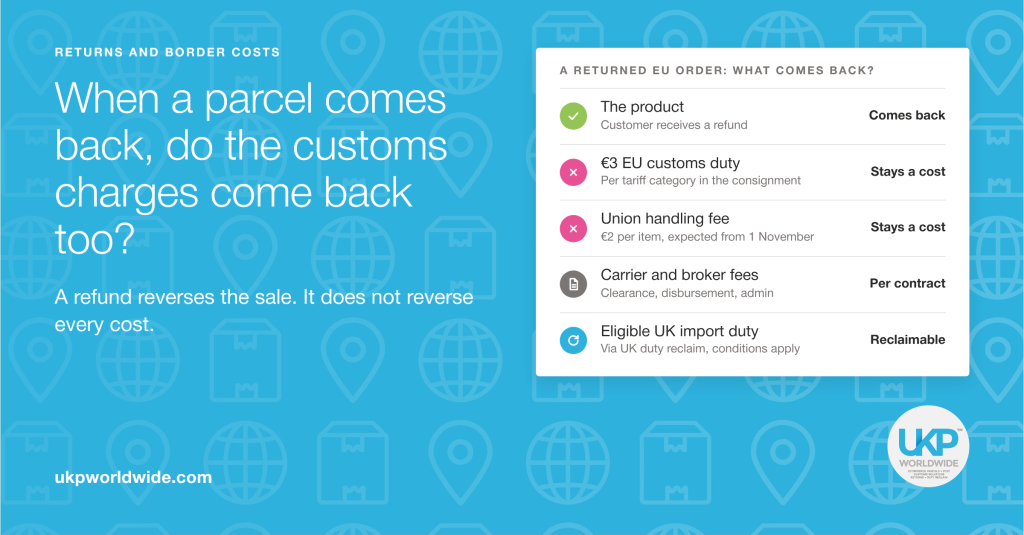
A returned eCommerce order reverses the sale, but it does not necessarily reverse every cost. The customer receives a refund or credit and the retailer gets the product back. Transport, processing and border charges can still leave a sizeable hole in the margin.
For retailers selling into the EU, the new customs arrangements make that distinction increasingly important. Ahead of November’s peak trading period and January’s returns, businesses need to understand which charges remain after an order comes back.
For businesses familiar with UK duty reclaim, there is an important geographical distinction. Recovering eligible duty paid on a UK import does not recover charges paid when a parcel entered the EU.
What has changed at the EU border?
Since 1 July 2026, an interim €3 customs duty has applied to qualifying low-value imports. It is calculated by tariff category within a consignment, rather than simply once per parcel. A parcel containing goods in two different tariff categories can therefore attract €6 in duty.
A separate Union handling fee is expected from 1 November 2026. The Commission’s October guidance specifies €2 per item and explains that qualifying distance sales above €150 are also within scope. When that guidance was issued, the delegated act setting the amount remained under scrutiny.
For retailers, these charges add another layer to the cost of serving EU customers. Their effect becomes particularly visible when the sale is refunded but the border costs remain.
Where UK duty reclaim fits
Our duty-reclaim service concerns eligible customs duty paid on goods imported into the UK and subsequently returned and re-exported, subject to the applicable repayment conditions. The relevant charge is the duty paid on the original UK import. A successful claim recovers an eligible UK customs payment; it does not recover duty or fees paid to EU customs authorities.
That distinction matters when a retailer operates across several markets. A returns programme may involve UK imports, EU imports and goods coming back to the UK after export. Each movement needs to be assessed separately. The starting point is therefore straightforward: where was the duty paid, on which import declaration, and what happened to those goods afterwards?
Do not expect UK duty reclaim to recover the EU €3 charge
The €3 charge is EU customs duty. It falls outside our UK duty-reclaim service. For ordinary customer returns, retailers should also treat it as an unrecovered cost under the current EU arrangements. Distance-sale consignments with an intrinsic value not exceeding €150 are excluded from the previous declaration-invalidation route for goods returned after release.
Returning an unwanted product does not therefore make the €3 duty refundable through that route. Although general statutory repayment grounds remain, they should not be presented as a routine recovery solution for ordinary returns. For commercial planning, retailers should not assume this charge comes back when the customer receives their refund.
Handling fees are separate from customs duty
The Union handling fee is expressly non-refundable once incurred through acceptance of the customs declaration. It is not included in UK duty reclaim. Commercial carrier and broker charges are separate again. Clearance, disbursement and administration fees relate to services provided, and any refund depends on the provider’s contractual terms.
Retailers should avoid grouping these amounts together as “reclaimable customs charges”. Customs duty, the Union handling fee, commercial fees and VAT need separate treatment.
A customer-facing refund and a customs repayment are also different transactions. The amount refunded to the customer does not establish what the retailer can recover from a customs authority or logistics provider.
Returning goods to the UK is another distinct process
When goods previously exported from the UK come back, UK Returned Goods Relief may be available, subject to the relevant conditions. This relief can prevent an additional import-duty charge on eligible goods returning to the UK. It is different from reclaiming duty already paid on a previous UK import.
It also does not repay the EU duty or handling fee incurred when the order entered the EU. For example, a retailer exporting an order from the UK to an EU customer may incur EU border charges. If the customer returns it, qualifying for relief on its re-entry to the UK does not reverse those EU charges.
Build the distinction into returns planning
Before peak season, retailers should record border costs by jurisdiction and charge type. UK customs duty potentially eligible for reclaim should be distinguished from EU duty, handling fees and commercial administration charges.
For UK claims, returns records should connect the goods to the original import declaration, duty payment and evidence of return and re-export. Recovery forecasts should reflect eligibility and the supporting documentation available.
For EU orders, routine €3 duty charges and non-refundable handling fees should remain in the expected returns cost.
UK duty reclaim can help recover eligible UK import costs. Understanding its scope and the EU charges that remain gives retailers a more accurate picture of returns profitability and helps protect margin through the busiest trading months.
Sources
- Council of the EU: New customs duty rules for small parcels. Covers the interim €3 duty and tariff-category calculation.
- European Commission: Guidance on the €3 customs duty and Union handling fee. Version dated 5 October 2026. Covers fee scope, returns restrictions and non-refundability.
- Irish Revenue: Refund of Customs Duty and VAT. Explains treatment of the €3 duty on change-of-mind returns.
- HMRC: Relief when re-importing goods to the UK. Covers UK Returned Goods Relief and eligibility conditions.